Jung at heart
A psychologist’s legacy continues to draw followers in Maine
By Amrita Narayanan Bruce
Anthony Stevens speaks at the Brunswick Jung Center October 12. Call (207) 729-0300.
Open the encyclopedia to the biography of Carl Jung and it sounds like his 1936 US tour was restricted to Cambridge, Massachusetts. History generally neglects the fact that the celebrated Swiss psychiatrist was lecturing at Harvard on “factors that determine human behavior,” when three of his students, New York-based Jungian analysts who were vacationing in Maine, invited him to come lecture here. Jung was apprehensive that Mainers would not be interested in Jungian psychology and that few others would be interested in traveling to such a remote location unless they were vacationing there anyway. When he eventually accepted the invitation, he continued to dawdle at Harvard, arguing that since he was only to lecture to a small vacation crowd they wouldn’t mind if he didn’t arrive on schedule.
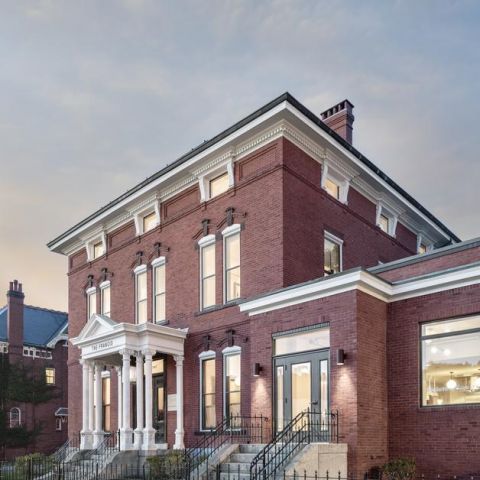
Local lore tells us that Jung did eventually spend a week on Bailey’s island that September, where over a hundred people attended his series of lectures chronicling and interpreting the dreams of one of his patients. One grateful participant, a New Yorker named Mildred Harris, took a significant step in ensuring Jung’s legacy for Mainers. She founded and endowed the C.G. Jung Center at 8 Cumberland Street in Brunswick with money earned from the sale of a Hans Hoffmann painting, though the center’s operations didn’t start until September 1989, just before her death in October. Harris, who retired from New York City to practice psychology and teach yoga in Maine, chose the location for maximum accessibility between Portland and Augusta and its proximity to
Bowdoin College, where there has been an annual Jung seminar since 1980.
Today, thanks to Harris, the Brunswick Jung Center is able to offer courses, films, lectures and retreats to its members and to the public; has a scholarship fund for those who are unable to afford its programs; and has recently decided to contribute money to the Boston Jung center, which is seeking funding to buy a permanent office. Its dedicated staff and significant funding have allowed the Maine Jung Center to command speakers of international repute. This Friday, October 12, British author and world-renowned psychiatrist Anthony Stevens will speak at the center for the second time, returning after a 12-year hiatus. The lecture, again thanks to Harris, will be free to the public in keeping with the center’s vision to expose Jung to as wide an audience as possible.
Stevens has written 11 books on Jungian psychology, including the much acclaimed On Jung that examines Jung’s personal and professional lives in tandem to explain how Jung’s theories grew out of his personal experiences. Stevens, who is from Devonshire, England, is credited with making invaluable contributions to Jungian thought in particular, and psychology in general. “He is the most important figure in the 20th century on connecting religion and psychology,” says Chris Beach, who formerly served as chair of the board of directors of the Brunswick C.G. Jung center.
This year, Stevens will lecture on “Archetypes, Jungian Psychology and the future.” In case you’ve never heard of an archetype or you skipped the Jung paragraph in your psychology 101 textbook, know that Stevens is well known to appeal to the young at Jung as well at the more experienced. “He is extraordinarily clear and knowledgeable and very good at conveying Jung and his ideas,” says Kate Potter, chairwoman of the board of directors of the Jung Center. “And his speeches always have lots of very relevant current examples.”
Archetypes, say the Jungians, are unconscious “primordial images” that cause us to experience life in a manner conditioned by the past history of mankind: for instance our ideas of heroes, villains, mother figures, or how to react to tragedy. Born of observations that human behavior in significant situations (birth, death, disaster) takes on a typical form, the archetype concept says the manner in which we act and react in these significant situations is affected by and mirrors the emotions of our remote ancestors.
Jung linked archetypes to symbols, pointing out that there are certain universally representative symbols that have appeared and reappeared in the dreams and drawings of people from all different ages and cultures. The poster advertising Steven’s talk, for example, has images of a circle, the sun, a tree, the mountains — illustrating the Jungian preoccupation with archetypal symbols. In particular, Jung emphasized the mandala, the decorative circular symbol that appears in many cultures. For instance, Tibetan Buddhists often spend days crafting “sand circles,” which they then dismantle. And Christian cultures often portray Christ within a decorative circular form.
To Jung, these symbolized “a center of personality, a kind of central point within the psyche, to which everything is related, by which everything is arranged, and which is itself a source of energy.” The shape of the mandala sums up what Jung believed to be the most important and lifelong task of any person — to find wholeness and fulfillment, to, in effect, come full circle. To feel whole.
If you are as surprised as everyone else that there is a Jung center in Maine or that Jung himself visited Maine, it’s interesting to note that Jungian psychology attracts the gamut of people. The center’s membership includes people from all walks of life and no more than one quarter of their members are in professions directly related to psychology. On a Tuesday evening it’s not uncommon to find Maine-based therapists, lawyers, teachers, artists, and doctors discussing dreams and unthought thoughts over cookies and lemonade. The gatherings include courses on interpreting dreams or Jungian interpretations of popular movies such as Secrets and Lies or What Dreams May Come.
While the Jungians are not from any particular profession, there is a definite slant towards the 35+ age group. “Jung’s work is a psychology that people are attracted to in the latter part of their life,” says Jeanne Rowan, program coordinator at the Brunswick C.G. Jung Center. Rowan explains that the issues of fulfillment and wholeness that are dealt with in Jungian psychology usually interest people as they grow older and begin to be dissatisfied with materialism and money making, tired of a problematic relationship, “or for whatever reason, the way they have lived their lives no longer works for them.” Jungian psychology also deeply addresses the question “what is coming next after I die,” another subject that might not occur to a younger person.
Take the overbooked “Fall Away Retreat” that the Jung center organized earlier this month. Amidst the autumn foliage, participants could consider what they might want or allow to “fall away” in their lives. To do this, they would think about that thing (say a desire for a big house or a certain relationship) and “make it more vivid like the autumn leaves” through journal writing and walks in the woods, eventually allowing it to fall away. By conceptualizing the thing fully, they identify it, then eliminate it.
If you are twenty-something and trying to get the scratch together to buy a house you might not look kindly on letting the desire fall away, which is perhaps why the Jungians tend to be 35+. Jung accepted that sexuality and the need for self-assertion (power; i.e. having a phat house) were the primary motivators in young people, but he believed that as one grew older there was a shift in motivations (unlike Sigmund Freud who believed that the sexual impulse continued as a primary motivation through life).
“Jung was profoundly concerned with life transitions, particularly those changes that one goes through at the middle of life. He said that he almost never met anyone over the age of 35 whose problems were not spiritual problems,” says Beach, who earned his diploma at the C.G. Jung Institute in Zurich, Switzerland, and has a private practice in Portland.
So how might a Jungian therapist be different from another psychotherapist? A key factor that distinguishes Jungian psychology is that the therapist is less likely to ask you to drastically change your behavior in order to adapt to the circumstances, and more likely to ask you about what messages about life your circumstances might be offering up. “Behavioral and cognitive therapists are going to work on changing your actions and thinking, but they are not likely to ask you if you had a dream last night” says Beach.
Dream-work — as the Jungians refer to the process of remembering, analyzing and interpreting dreams — forms an important part of the Jungian method. Jung spent considerable time in primitive cultures observing the value attached to the “collective dream.” For example, note the fact that nomadic arctic tribes would move over the ice for days in search of (and successfully finding) a new place to live because of a dream experienced by one of its tribe members. Based on his studies, he argued that dreams are a natural and spontaneous production of the psyche and are worth taking seriously.
We’ve all experienced dreams that shook us up. Usually we try to forget them or tell our friends about it and hope they will assure us that it was nonsense. Or we react irrationally. For example, maybe you have had a recurring dream about a dog trapped in a house, crying because of its predicament, and are now convinced you need to get a bigger yard for your real-life puppy.
A Jungian psychologist would sit down with you to examine the meaning of such a dream, and might even come to the conclusion that the dog in the dream represented you, trapped by too many TV dinners (the self is often symbolized as an animal in dreams say the Jungians). Or maybe after a few sessions with this psychologist, you remember that in the dream the dog had a circular symbol on it. The psychologist might point out that the dreaming of a circular mandala reflects a desire for self-fulfillment and they could then talk about how that might come about (say, more intimate dinners with your spouse). The example is simplistic but you get the picture. Unlike the more oft-referenced Freudian dream theory, Jungian thought isn’t all about sex.
“At a time of misery and uncertainty in my forties my night dreams were tremendous guides,” says Potter, a retired Maine psychotherapist who received assistance in understanding the meaning of words and images in her dreams at a Jungian center in Texas. “I think Jung’s gifts as doctor, psychologist, and prophet were to formalize key concepts and make them relevant to educated humans who want to understand relationships, other cultures, and how to become more alive and spiritual as they approach old age,” she adds, reiterating the link between self-fulfillment and spirituality conceived of by Jung.
“Being a Jungian means being open to the importance of the spiritual or religious impulse that resides in every person, whether they are aware of it or not,” says Beach. “It helps me see the links between the various religions and spiritual practices and to know that people need to feel connection to something greater than themselves, and to find a meaning in life as much as they need to find a sexual outlet, or to find food to nourish their bodies.”
Jungians must also come to terms with what Jung termed the “shadow” side of our personality — our negative side, the hidden or repressed side of our character that is nefarious. Since integrating Jungian thought into his life, Beach says he is much more likely to question his own role in causing a problem at work or in a relationship with another person. “How is my shadow (the backside of my personality, which is hard for me to see) tripping me up or being unconsciously projected onto another so that I reject that person?” Beach asks of himself in problematic situations.
“Jung’s concepts of the shadow have opened possibilities of accepting dark parts of myself,” says Potter, who, like other Jungians, believes that accepting darkness and negative qualities in ourselves allows us to accept them in other people. Since Jung dealt with the individual as well as the collective consciousness, Rowan puts the September 11th attacks in the context of Jungian psychology and the shadow: “We all have to be able to look at bin Laden and say ‘that’s me, there is terrorist potential in me, too.’ ” Rowan believes that Anthony Stevens’s discussion of Archetypes will help listeners adopt a more compassionate attitude towards the terrorists and give them a container in which to put the September 11th attacks.
“Jungian psychology provides a framework for examining your life, seeing parts of yourself that you haven’t known or haven’t wanted to see — good as well as bad, wonderful as well as difficult” says Beach.
How could you not be seeing yourself? Well, say for a while now you have been progressing in your work as a marketing manager but you keep telling yourself that someday you will give time to what you really care about — music. You push this to the back of your mind, however, until you begin to have a series of recurring nightmares in which you are being dragged out of bed. After discussing this dream with your Jungian therapist, you might recognize that the person dragging you out of bed was also yourself, driven by the impulse to seek fulfillment through your music, and this information might help you work towards your goal.
“Looking at yourself within the Jungian framework may enable you to live life more deeply and spiritually, and more broadly — going out into the world and trying things you have never before dared to try,” says Beach. “What Jungian psychology offers such a person is a very different way of looking at life and the world. It’s a more spiritual, introverted, self-examining way, and a humble acceptance that there is much about oneself that one does not know and that for the sake of oneself and others the time to ‘know thyself’ has come.”
Amrita Narayanan Bruce can be reached at amritabruce@yahoo.com.